Hungarian water technologies in Vietnam - Hungarian–Vietnamese cooperation Expands
Content
Puraset’s regenerable adsorbent technologies and PurAID® modular drinking water treatment system were presented in Vietnam as part of a Hungarian initiative aimed at strengthening cooperation in water management and introducing sustainable Hungarian technologies to the Southeast Asian market.
The Connecting Continents 2026 workshop was held on 14 September at Hung Vuong University of Ho Chi Minh City, in cooperation with the Hungarian Water Partnership (HWP) and the Consulate General of Hungary in Ho Chi Minh City. The event brought together Vietnamese and Hungarian experts to discuss water, food safety and sustainable technological solutions, while creating new opportunities for professional and business cooperation.
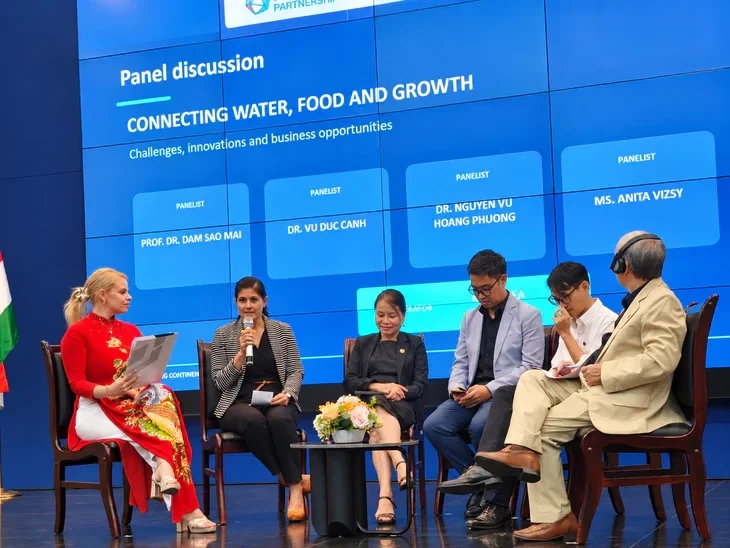
Vietnamese and European experts discussed a wide range of water-related issues and water technologies at the workshop. Photo: Trọng Nhân
For Puraset, Vietnam represents a particularly relevant market. Rapid urbanisation, increasing water demand, climate change and the varying quality of available water resources are creating a growing need for treatment technologies that are not only effective, but also sustainable, adaptable and economical to operate over the long term.
Regenerable adsorbents for sustainable water treatment
Among the Hungarian solutions presented at the workshop was AsMET, Puraset’s regenerable adsorbent filter developed for the removal of arsenic from water.
AsMET is capable of removing both As(III) and As(V) forms of arsenic and, unlike conventional single-use filter media, the adsorbent can be regenerated and returned to service. This significantly reduces the amount of waste generated during operation and supports a more circular approach to drinking water treatment.
Regeneration is at the heart of Puraset’s adsorbent technology. Instead of disposing of saturated filter material and continuously replacing it with new media, the adsorbent can be cleaned and reused. In addition to its environmental benefits, this approach can provide important life-cycle cost advantages for water utilities and operators.
PurAID®: decentralised drinking water treatment for communities
The workshop also highlighted PurAID®, Puraset’s compact, modular drinking water treatment system designed especially for rural, isolated and less accessible communities.
A single PurAID® unit can treat approximately 6,000–10,000 litres of water per day, depending on local conditions and treatment requirements. Units can be installed individually or connected into a modular network to serve a larger population.
The system can operate using grid electricity or solar power, making it particularly suitable for areas where centralised water-supply infrastructure is limited or where flexible, decentralised solutions are required. Remote monitoring also enables multiple installations to be supervised centrally.
By combining Puraset’s water treatment technologies with a compact and scalable system design, PurAID® provides an opportunity to bring safe drinking water closer to the communities that need it, without requiring the construction of large-scale centralised infrastructure.
Technology already proven in Vietnam
Puraset’s technology has already gained valuable local experience in Vietnam.
In 2024, AsMET and PurAID® were tested in Hanoi during a six-month pilot project, operating at a treatment capacity of approximately 10 m³ per day. According to the results presented by the Hungarian Water Partnership, the system achieved an arsenic-removal efficiency of more than 95%, while arsenic concentrations in the treated water remained below 10 micrograms per litre.
For Puraset, local pilot projects are an important step in introducing water treatment technologies to new markets. Testing under real operating conditions makes it possible to understand local raw-water characteristics, optimise the treatment process and develop solutions that respond to the specific needs of communities and operators.
Vietnam as a gateway to wider regional cooperation
Water-management challenges identified by Hungarian and Vietnamese experts include arsenic contamination, decentralised drinking water treatment, wastewater reuse, saline-water treatment, flood and drainage management, and the increasing impacts of climate change on water security.
Vietnam’s water sector is also growing rapidly. Increasing urban demand, combined with increasingly complex water-quality challenges, is driving the need for advanced treatment technologies and flexible infrastructure.
These conditions make cooperation between technology providers, water-sector organisations, research institutions and universities increasingly important.
The Hungarian approach presented at the workshop places particular emphasis on combining technology transfer with research, professional training and pilot projects. For Puraset, this model is closely aligned with our own approach to international projects: successful water treatment is not simply a matter of supplying equipment. Local validation, knowledge transfer, appropriate operation and long-term technical cooperation are equally important.
Vietnam can therefore become not only a market for Hungarian water technologies, but also an important regional reference point for further cooperation across Southeast Asia.
We look forward to strengthening cooperation with Vietnamese partners, expanding local pilot and reference projects, and exploring how Puraset technologies can contribute to safe and sustainable drinking water supplies in Vietnam and throughout Southeast Asia. We would like to thank HWP for organising the workshop and for the professional support they are providing.
Image gallery
Three more PurAID® units in Ghana
Image gallery

Intro
Provided to the construction camp for engineers and contractors building a road network, three of our plants purify drinking water
Properties
- Subtitle
Arsenic removal in Cociuba
Image gallery

Intro
Cociuba Water Treatment Plant – Ammonium and Arsenic Removal Technology
Properties
- Subtitle
Superconducting bonds in CERN
Image gallery

Intro
Our last research for CERN was to develop a technology that allows the splices of low-temperature superconducting cables to be in a superconducting state as well, meaning that no voltage is applied to them.
Properties
- Subtitle