In sustainable water utility developments, investment cost is not the most important consideration
Content
Reducing arsenic concentrations in drinking water remains a significant water quality challenge in many regions. However, the solution is not simply about meeting the regulatory limit: operability, cost-effectiveness, and long-term sustainability are equally important. The arsenic removal project at the Cociuba Mare Water Treatment Plant in Bihor County, Romania, based on regenerable adsorbent technology, is a good example of how the right technological decision can not only ensure safe drinking water quality, but also reduce waste generation, support circular operation and provide a more favourable solution from a life-cycle cost perspective. The project also demonstrates an engineering approach in which the most advantageous solution should be selected not on the basis of the initial investment cost, but on the basis of the total cost over the entire life cycle.
The article, published in the July issue of the official journal of the Hungarian Chamber of Engineers, focuses on the engineering aspects of the arsenic challenge, the process of selecting an appropriate water treatment technology for arsenic removal, and the principles and operation of regenerable adsorbent-based technology. Based on these considerations, it also examines why the lowest initial investment cost alone is not sufficient when selecting an arsenic removal technology. In presenting the engineering and economic framework for decision-making, the article highlights the importance of economic calculations and the advantages of applying Dynamic Cost Comparison (DCC) and Life-Cycle Costing (LCC) methodologies to support the preparation and evaluation of alternative solutions for water utility investments.

As a case study, the article presents the arsenic removal process applied at the Cociuba Mică Water Treatment Plant, including its design challenges, the implementation process and the results of the investment.

The professional article published in the journal also highlights that regenerable adsorbent-based arsenic removal is not merely a solution to a specific water quality challenge, but a key element of sustainable solutions supporting the transition towards a circular economy. The arsenic removal project in Cociuba Mare is not an isolated technological case; rather, it reinforces the professional approach represented by the life-cycle perspective promoted jointly with the Hungarian Chamber of Engineers, the Hungarian Water Association (HWA), and other professional stakeholders. This approach calls for moving beyond the lowest initial investment cost and instead identifying the solution that offers the best overall value, can be operated reliably over the long term, and is sustainable.
The article is available digitally here: https://mernokvagyok.hu/wp-content/uploads/2026/09/Mernok-Ujsag-2607.pdf, page 32.
The topic has generated considerable professional interest not only in Hungary, but also internationally. The article was also published, with unchanged content, in Revista ROMAQUA, the official professional journal of the Romanian Water Association (ARA): https://www.ara.ro/sp/romaqua
Image gallery
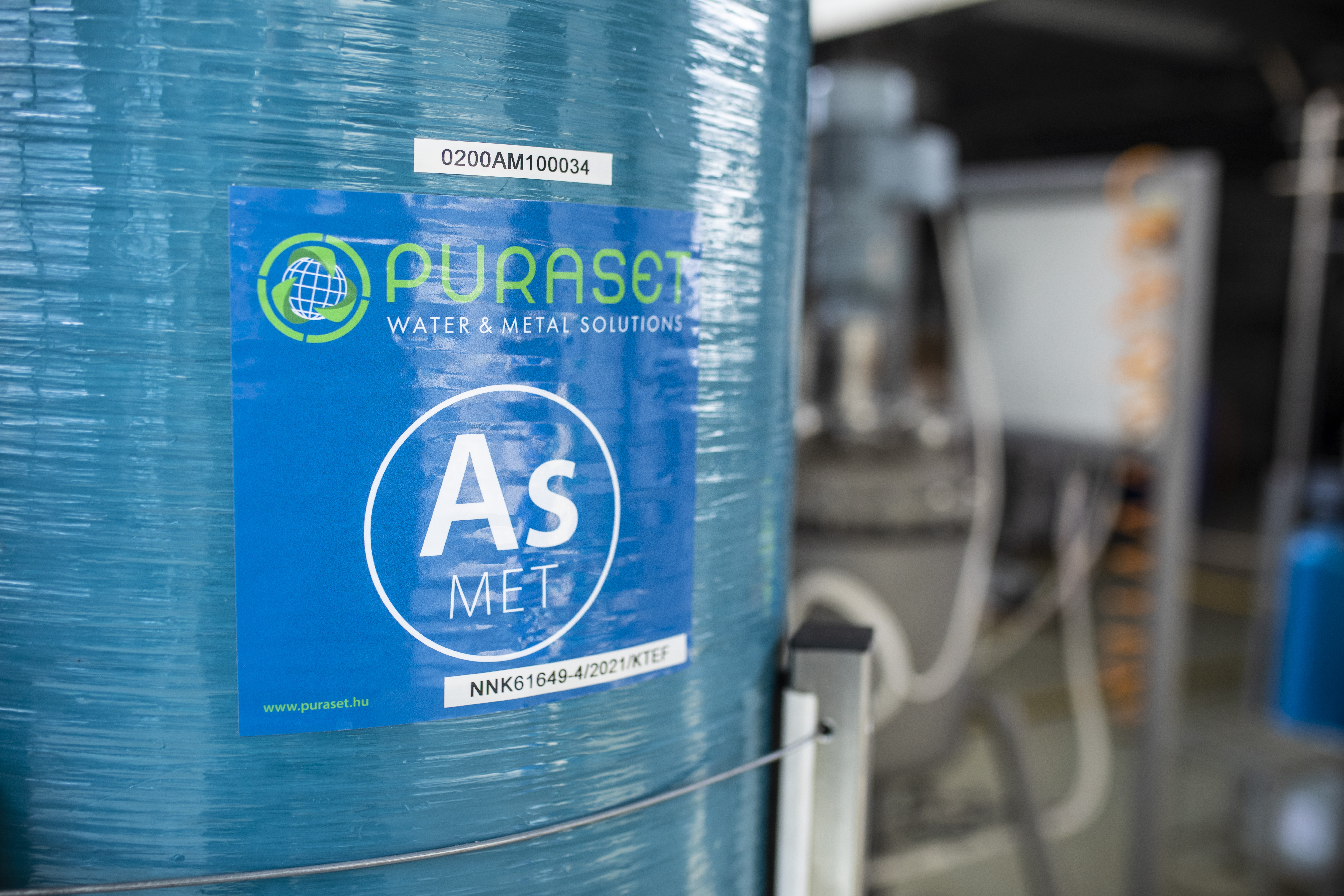
Arsenic-removal tanks
Image gallery

Intro
Our company placed its PuraWell arsenic-removing tank at the kindergarten of Rinyaújlak fitted to a wall fountain.
Properties
- Subtitle
Arsenic removal in Tiszagyenda
Image gallery

Intro
Our latest domestic reference - adsorbent removal project in Tiszagyenda
Properties
- Subtitle