Reference site visite in Cociuba
Content
At the end of June 2026, Puraset Ltd. organized a technical reference site visit to the Cociuba water treatment plant (Romania, Bihar County), where participants were able to learn about the operation of the regenerable adsorbent-based arsenic removal technology. In addition to Hungarian water utility providers, the event was attended by experts from the water utilities of Arad, Timișoara, and Oradea, as well as the mayor of Cociuba and the two clients of the project. The meeting provided an excellent opportunity to exchange professional experiences and learn about long-term sustainable drinking water treatment solutions.

In the photo, from left to right: Péter Bolgár, Róbert Forintos, Bálint Horváth, Dániel Horváth (Puraset Ltd.)
The Cociuba project clearly illustrates that, when it comes to arsenic removal, it is not enough to focus solely on meeting regulatory limits. When selecting the appropriate technology, factors such as operational reliability, operating costs, sustainability, and total life-cycle costs are at least as important.
The water treatment plant has a daily nominal capacity of 792 m³, and the primary function of the technology is to reduce arsenic and ammonium levels. Due to the characteristics of the raw water—variable arsenic concentrations and the predominance of trivalent arsenic (As(III))—conventional iron-based technologies were unable to deliver satisfactory results. The project was therefore based on regenerable adsorbent-based technology, which ensures stable water quality even when raw water quality fluctuates.
One of the solution’s most important advantages is that the adsorbent bed is regenerable, eliminating the need for regular replacement of the filter media and its disposal as hazardous waste. This significantly reduces waste generation and operating costs while supporting a circular economy approach. Another advantage of the plant’s design is that regeneration does not take place on the water utility’s premises. Only the backwashing of the filter media occurs on-site, so there is no need to store or handle regeneration chemicals, and no arsenic-contaminated wastewater is generated at the plant.
The reference project in Cociuba has once again confirmed that the key to the success of modern water treatment investments is not the lowest possible capital cost, but rather the selection of technology that can be operated economically, safely, and sustainably throughout its entire life cycle. Participants in the technical seminar were able to see for themselves on site that regenerable adsorbent-based arsenic removal offers a solution that is both competitive in the long term and environmentally beneficial for treating water sources contaminated with arsenic.
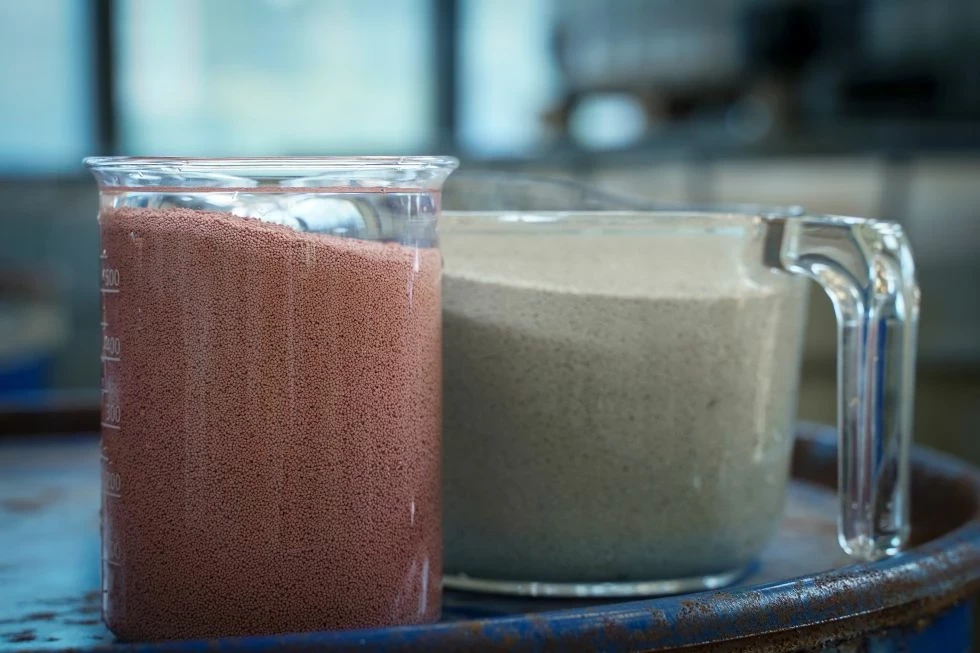
Image gallery


Vietnam Arsenic removal
Image gallery

Intro
Our expansion into the Far East began with Vietnam, where arsenic contamination of drinking water is a huge problem
Properties
- Subtitle
Superconducting bonds in CERN
Image gallery

Intro
Our last research for CERN was to develop a technology that allows the splices of low-temperature superconducting cables to be in a superconducting state as well, meaning that no voltage is applied to them.
Properties
- Subtitle
Development of control rod used in reactor technology
Image gallery

Intro
In 2019, we developed a reactor technology control rod for the Eötvös Lóránd Research Network - Energy Science Research Center, in which the desired parameters were achieved by blasting, while the gas tightness was achieved by electron beam welding.
Properties
- Subtitle